
 Share
Share 



Field bets were the most popular individual craps wager in a Hard Rock Bet study covering New Jersey and Michigan, despite offering less favorable odds than several alternatives.
The study also found that higher-risk wagers accounted for just 16% of craps bets but generated approximately 38% of casino profit.
Hard Rock Bet released the report Sept. 30 after analyzing more than 3.3 million craps bets from April through June. The results reflect betting across both states, with no separate New Jersey figures.
For NJ online craps players, the report illustrates how wagers on the same table can carry substantially different costs. A larger potential payout can come with a higher casino advantage, increasing a player’s expected losses over time.
Bigger payouts can come with a higher cost
The house edge measures the casino’s mathematical advantage over repeated play. A lower percentage means a smaller expected loss relative to the amount wagered, although individual sessions can produce very different results.
Under standard rules, Pass Line bets have a house edge of approximately 1.41%, while Don’t Pass bets carry an edge of about 1.36%. Both pay even money when they win.
By comparison, an Any Seven wager offers a 4-to-1 payout but carries a house edge of approximately 16.67%. It wins only if the next roll totals seven.
Seven can appear in six of the 36 possible two-dice combinations, making 5-to-1 the fair payout. The smaller 4-to-1 payment creates an expected loss of roughly $16.67 per $100 wagered over many bets, rather than a predictable loss in any single session.
Field was the most popular individual bet
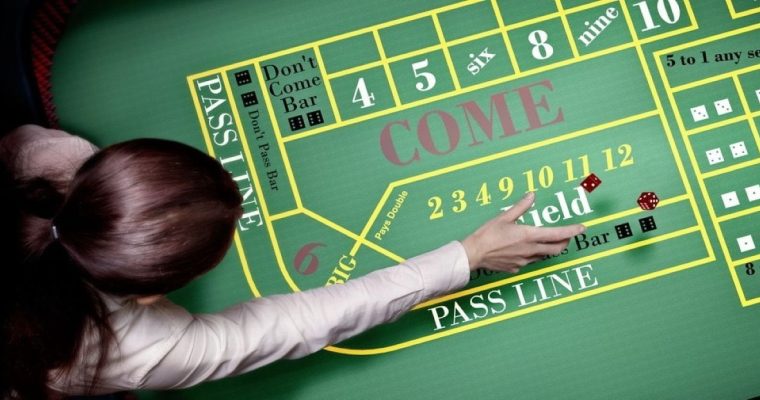
The Field was the most frequently selected individual wager in Hard Rock Bet’s sample, surpassing the Pass Line and each individual Place bet. Proposition bets on two, three, 11, and 12 together represented more than 20% of selections.
A Field bet is settled on the next roll and wins on two, three, four, nine, 10, 11, or 12. It loses on five, six, seven, or eight.
Although it covers more winning totals than losing totals, those totals are not equally likely. The losing numbers account for 20 dice combinations, compared with 16 for the winning numbers.
Field bets generally pay even money, with larger payouts on two and 12 that vary by game. Checking those payouts helps players understand the house edge before wagering.
Place bets collectively accounted for 39% of the study’s wagers. Within that category, Place 6 and Place 8 represented 43.5%, compared with 22.9% for Place 4 and Place 10.
Under standard payouts, placing six or eight carries a house edge of approximately 1.52%, compared with 6.67% for four or 10.
Odds bets have no house edge but require additional money
Odds bets made up just 2% of selections in the report.
These wagers supplement an existing Pass Line, Don’t Pass, Come, or Don’t Come bet once its point is established. They pay true mathematical odds, leaving the casino with no advantage on that additional amount.
Taking odds on a Pass Line or Come bet pays 2-to-1 on four or 10, 3-to-2 on five or nine, and 6-to-5 on six or eight.
The original wager still carries a house edge, and adding odds puts more money at risk if the bet loses.
NJ’s responsible gambling tools include deposit, spending, and time limits. Those limits can help players manage their overall gambling budget regardless of which craps bets they choose.