
 Share



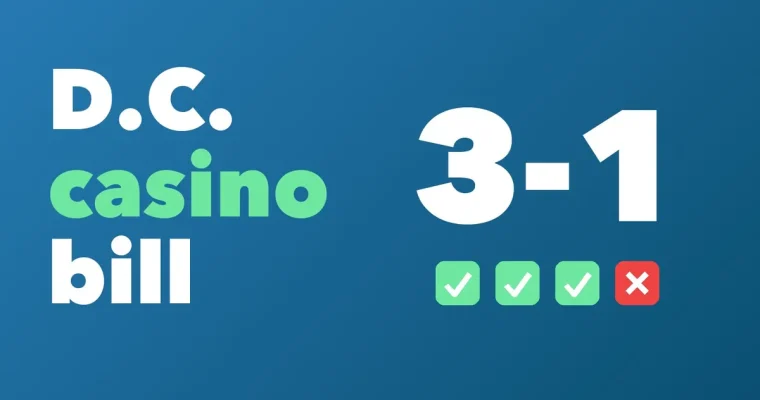
A D.C. Council committee voted 3-1 on Nov. 18 to send the District’s online casino bill to the full Council, after rewriting it so that sweepstakes-style casino games would be licensed and taxed instead of banned. Councilmember Christina Henderson cast the only no vote.
The Committee on Human Services marked up B26-0656, the Internet Gaming and Consumer Protection Act of 2026, at its session on Nov. 18, according to the Council’s legislative record. Councilmember Wendell Felder introduced the bill on April 9. It had not moved since a public hearing on May 4.
The vote leaves the bill less than four weeks to clear the full Council.
What the committee changed
As introduced in April, the bill made it illegal to run an unlicensed online platform built on dual currencies. Sweepstakes casinos run on that model. Players buy one kind of coin to play for fun and get a second kind that can be redeemed for cash prizes.
The committee version pulls those games inside the licensing system. A fiscal impact statement from the Office of the Chief Financial Officer, dated Nov. 18 and written on the draft committee print the office received a day earlier, describes internet gaming under the bill as “participating in a casino-style game, or a social plus sweepstakes style game conducted through an internet gaming platform.”
In practice, a sweepstakes operator that wants to keep serving District players would need the same license as any other online casino, pay the same tax and follow the same player-protection rules. The Office of Lottery and Gaming could order unlicensed sites to stop and take them to court, and the attorney general could sue as well.
That runs the opposite way from New Jersey, where licensed online casinos have operated since 2013 and lawmakers banned sweepstakes casinos outright in August 2025.
Henderson has raised concerns about problem gambling and pointed to higher bankruptcy risk in states that expanded online betting.
The terms in the committee version
Licensed operators would pay a 25% tax on adjusted gross revenue, above the 19.75% New Jersey charges its online casinos. Revenue from live-dealer games would be taxed at 12.5%. On top of the tax come two assessments of 2% each, one for community impact programs and one to pay for regulation.
An operator license would cost a $2 million application fee, with a $1 million renewal every five years. Each licensee could run no more than two brands, and every operator would have to stream live-dealer games from a studio inside the District, with licensed dealers covered by a labor peace agreement. Applicants would also have to show that at least 35% of their District operating budget for online gaming goes to certified local businesses, or get a waiver from the Department of Small and Local Business Development.
The CFO’s letter to Council Chairman Phil Mendelson says the bill “legalizes internet gaming with licensed vendors in the District and increases the age that an individual may participate in any legal gambling activity (except the Lottery) from 18 to 21.”
Players would get deposit, spending, loss and time limits, cooling-off periods of at least 72 hours and self-exclusion. Promotional credits would be capped at 1.75% of an operator’s adjusted gross revenue. The CFO projects a cost of $246,000 in fiscal 2027 and a net gain of $58.7 million through fiscal 2030, with no gaming revenue arriving before fiscal 2028, which starts Oct. 1, 2027.
What has to happen next
The bill now needs two votes of the full Council at separate legislative meetings. The first is expected on Dec. 1. Both have to happen by the Dec. 15 legislative meeting, the last one of the current Council period, or the bill dies and has to start over in 2027.
A bill the Council passes goes to Mayor Muriel Bowser. Congress then gets a fixed review window, which every permanent D.C. act has to clear before it takes effect.
Even a law on the books would not open the market right away. According to the CFO’s statement, the bill gives the Office of Lottery and Gaming 120 days from the law’s effective date to open applications and sets a 120-day target for launch, which the mayor can extend in writing. The office has told the CFO it needs six months to build the staff and systems to start.
Until then, District players have no licensed online casino. Many end up on offshore sites of the kind that topped Google’s US results for best online casinos when PlayNJ checked them on Nov. 17. None of those sites is licensed by any US state.
Where that leaves the rest of the map
No licensed operator has taken its online casino into a new state since Aug. 27, when bet365 launched in West Virginia. That came four months after the Michigan Gaming Control Board approved bet365’s Michigan launch on April 17. The next openings depend on new markets, and Maine and D.C. are the two closest.
Maine already has its law. Caesars has an agreement with three of the four Wabanaki Nations to run its apps there once the state approves them.
| State | Status | Next date |
|---|---|---|
| Maine | Legal under LD 1164 since January 2026, for the four Wabanaki Nations only; rules, licensing and a Churchill Downs lawsuit still open | Regulator targets the first quarter of 2027 for launch |
| Virginia | SB 118 and HB 161 each passed one chamber and died in conference in March | 2027 session opens Jan. 13; a new bill is needed |
| Ohio | HB 298 stuck in committee; sponsor won’t move it in the lame-duck session; Governor-elect Amy Acton has said she is open to regulated online casinos | Bill dies when the General Assembly ends in December; Acton takes office in January |
| New York | S2614 dropped in June without Gov. Kathy Hochul’s support | Legislature returns Jan. 6 |
21+. Gambling problem? Call 1-800-GAMBLER.